
As a marketing and lead generation agency specializing in the B2B space, we know B2B discovery has always been research-intensive. Long sales cycles, multiple stakeholders, and high-stakes decisions mean buyers need confidence in your solutions before they’ll reach out.
In recent decades, buyers relied on search engines, industry publications, and (perhaps most importantly) peer recommendations to find the best vendors or solutions on the market.
Peer relationships and recommendations still matter in the B2B space, but more and more buyers are turning to AI search to compare vendors and summarize expertise early in the buying journey. Large language models (LLMs) like ChatGPT and Google’s Gemini are quickly becoming the first interpreter of a brand, synthesizing information from across the web and delivering it in conversational summaries that influence the direction of the buyer’s journey.
If your brand is selling products or services to other businesses, you need to be ready.
What B2B Brand Discovery Looks Like in an AI World
Until just a few years ago, B2B success in the digital space boiled down to SEO performance. If your brand had the right keywords, rankings, and optimized landing pages, you were in the conversation.
AI-driven discovery works differently. Instead of surfacing individual pages, LLMs assemble narratives. They pull from dozens of sources to generate synthesized answers, contextual explanations, and early-stage recommendations.
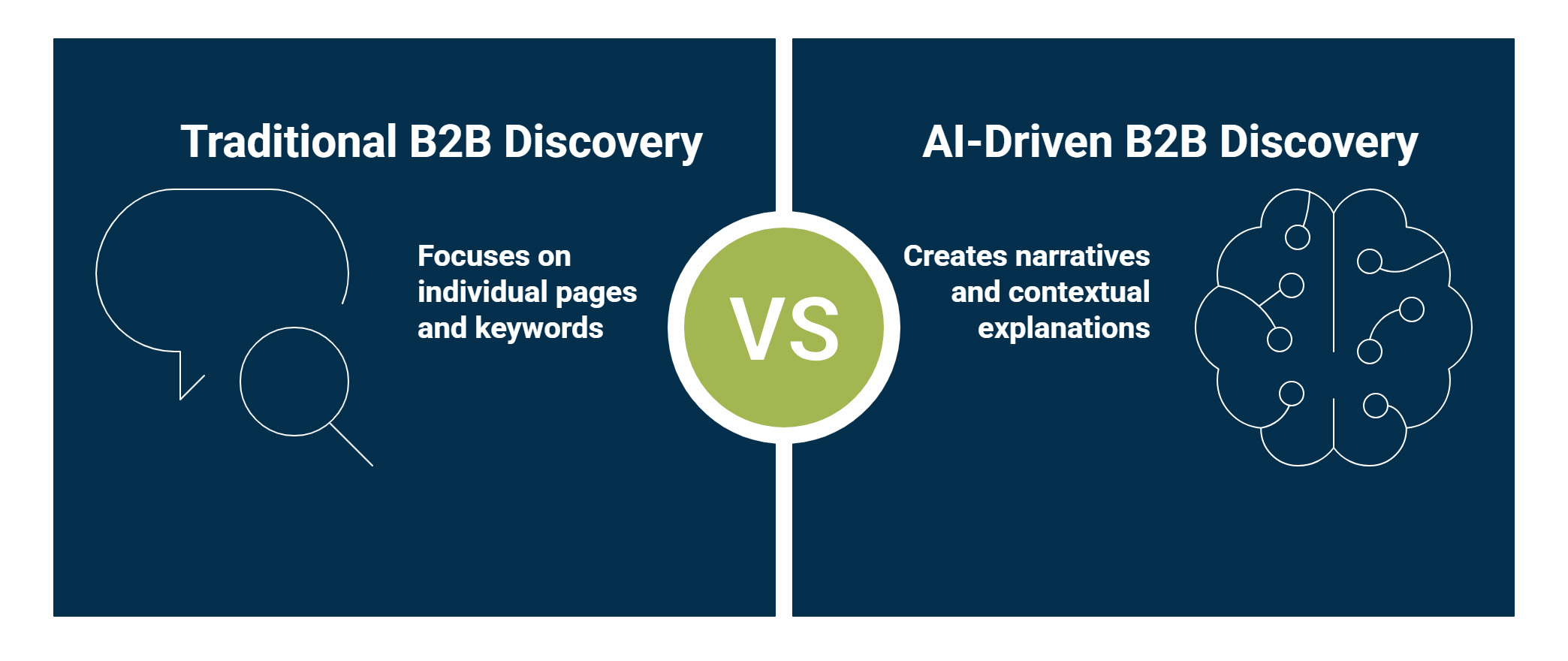
The difference matters. Brand perception is no longer shaped by an ad campaign or a microsite in a vacuum. It's formed across an entire content ecosystem, through the language you use, the depth of your expertise, and how consistently you present what you do.
Even if you have a great, detailed website, paid ads and an awesome YouTube channel, your buyer may not see it because you’re not being recommended—or even accurately reflected—by their LLM of choice.
LLMs Are Becoming Industry-Specific Discovery Tools
OK, you say, "let's make sure we’re optimized for AI search"—but what does that mean in the B2B market?
A recent analysis of millions of LLM sessions shows that B2B’s adoption of AI is actually fragmenting by industry and use case. While ChatGPT still commands the largest overall share of AI discovery, different platforms are winning in different environments based on how professionals actually work.
Clear patterns are emerging, per SEJ’s research:
- Enterprise and SaaS teams are increasingly discovering inside Microsoft ecosystems. Copilot’s biggest growth is concentrated in industries where work already happens in Excel, Outlook, and Teams. Research is no longer a separate activity; it now happens in the middle of execution.
- Finance professionals prioritize verifiable, citation-backed responses. Perplexity has gained meaningful traction in the financial world because it emphasizes transparent sourcing and institutional data.
- Developers, analysts, and strategists lean toward deep-reasoning tools. Claude is gaining traction among technical and analytical users who upload large documents, codebases, or datasets for synthesis.
- Some AI-driven discovery is becoming invisible. Platforms like Gemini increasingly retain users within their ecosystems, meaning research may influence branded searches or delayed conversions without showing up in traditional analytics.
These patterns matter because discovery is no longer happening in a single, universal search environment. It’s happening inside the platforms buyers use to execute their work, validate decisions, and interpret information. Your brand needs to be there.
Why Industry-Aware Language Matters More Than Ever
We've written before about why AI search demands consistent branding, and that principle matters even more as LLMs synthesize information from dozens of sources.
When your brand shows up differently across those sources, AI tools struggle to build a coherent picture of what you do.
Brand consistency used to focus on visual identity and tone of voice. In the era of AI search, it must also extend to industry terminology, problem framing, and outcome-oriented language. It also needs be consistent with your buyers’ intent.
- A manufacturing firm might describe “turnkey fabrication solutions,” while buyers are asking AI about reducing downtime or improving throughput.
- A consulting firm may promote its “advisory services,” but buyers are searching for regulatory compliance or operational transformation.
When internal language doesn’t match the terms and frameworks buyers use, AI systems can misinterpret where you fit.
One of the biggest risks for B2B brands is relying too heavily on internal shorthand. When your messaging is disconnected from the language your audience uses, your positioning becomes diluted before a buyer ever visits your site.
Generative engine optimization doesn’t mean rewriting your message for every LLM. It means aligning your language with how your industry is understood and discussed so that when AI systems interpret your content, they get it right.
Related: See how AI search is changing the metrics we use to define success in today's digital marketing campaigns.
What a B2B Brand Strategy Needs to Do Now
So what’s a modern brand to do? The answer isn't to chase every LLM—it's to build a brand strategy that holds up no matter where or how your content is interpreted. Here are some places to start:
Lead With Positioning Before Tactics
Clearly define who your brand serves, the problems you solve, and why it matters. Then reinforce that positioning everywhere.
If your messaging shifts depending on the channel, you're making it harder for AI systems (and buyers) to understand what you actually do.
Build Topic Depth, Not Just Content Volume
Focus on fewer, more meaningful subject areas. Demonstrate expertise through depth and clarity rather than trying to cover everything.
LLMs reward authority and coherence, not keyword stuffing or surface-level content.
Unify Language and Narrative Across Teams
Align terminology for your services and outcomes across every touchpoint, from LinkedIn thought leadership and blog content to case studies, sales one-sheeters, and proposals. If marketing calls it “operational efficiency” but sales refers to “process improvements,” you are sending mixed signals.
That inconsistency fragments your narrative for buyers and makes it harder for AI systems to accurately interpret and position your brand.
At Informatics, we've started conducting GEO audits for B2B brands to analyze how their content is being seen and optimized in the eyes of AI search tools. These audits evaluate brand clarity, industry-aligned language, and content consistency, identifying gaps between intended positioning and AI-generated perception. Understanding how AI interprets your brand is the first step to ensuring your expertise is visible where it matters most.
Understand How AI Is Interpreting Your Brand
AI-driven discovery is already shaping B2B perception. Discovery now varies by industry, tool, and workflow. Most B2B brands don't know how they're being interpreted or where those interpretations are happening.
If buyers in your industry asked AI to explain who you are today, would it get the story right?
If you're not sure, it might be time to find out. Reach out to us if you're interested in a GEO audit to see how your brand is showing up in AI-driven discovery.
Is Your Brand Ready for AI-Driven Discovery?
Our team can help you understand how AI interprets your brand and strengthen your visibility where it matters most.